Review: I’m the Crazy Sister Design for Embroidery
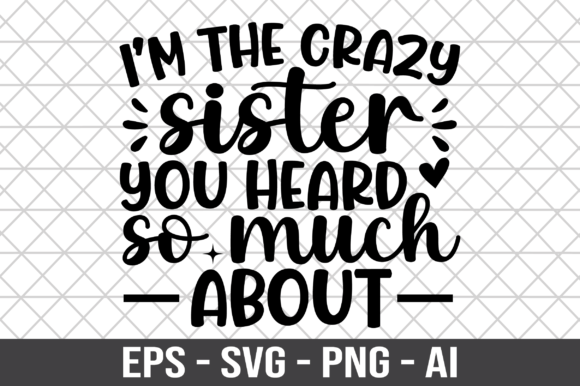
As a designer who has spent countless hours digitizing and testing embroidery files, I approach every new asset with a mix of curiosity and caution. We have all been there: you find a cute graphic online, download it, and then spend three hours troubleshooting why the stitches are pulling or the text is illegible. That is why when I came across I m the Crazy Sister You Heard so Much, I didn’t just look at the preview image. I looked at the potential for real-world application. This isn’t just a digital file; it is a statement piece for a specific niche, and its success depends entirely on how well it translates from screen to fabric.
The first impression of this design is bold and playful. The phrase itself carries a lot of personality, tapping into the popular "crazy sister" trope that resonates deeply in family-oriented gift markets. From a layout perspective, the typography needs to carry the weight of the joke. If the letters are too thin, they get lost in the texture of the fabric. If they are too dense, the garment becomes stiff. In my evaluation of this machine embroidery design, I focused on whether the visual balance supports the humor without compromising structural integrity.
Real-World Application: The Tote Bag Test
To truly understand the value of this embroidery file, I imagined a specific scenario. A client wants a custom tote bag for a bachelorette party or a birthday gift for a sibling. They want something durable, funny, and Instagram-worthy. I visualized placing I m the Crazy Sister You Heard so Much on a heavy canvas tote. Canvas is forgiving, but it has a distinct weave. A design with poor stitch density would look sparse and amateurish here.
Because this product includes vector formats like AI, EPS, and SVG, along with a transparent PNG, the versatility is high. However, as an embroiderer, I am primarily concerned with how the design scales. If I resize the SVG for a smaller hoop, do the details hold up? For a tote bag, I would likely aim for a width of about 6 to 7 inches. At this size, the lettering needs to be thick enough to prevent the background fabric from showing through excessively. The "crazy" aspect of the design suggests a fun, perhaps slightly irregular font choice, which can be tricky. Irregular fonts often have varying stroke widths, requiring careful attention to stitch density to ensure uniform coverage.
Fabric Considerations and Stitch Performance
Not every fabric treats a design kindly. When working with I m the Crazy Sister You Heard so Much, fabric selection is critical. For a sweatshirt embroidery project, the plush texture of fleece or French terry can swallow thin lines. If this design relies heavily on fine details, it might get lost on a hoodie. In such cases, I would recommend using a satin stitch border around the text or increasing the overall size to maintain clarity. Conversely, on a smooth cotton twill or a polished shirt, the same design would pop with crisp edges.
Stretchy fabrics present another challenge. If you are applying this to a baby onesie for baby embroidery, you must use a cut-away stabilizer. The phrase is humorous, but if the stitches pucker the fabric, the joke is lost on the poor execution. The transparent PNG included in the download is useful for creating mockups, but it does not tell you how the stitches will behave on stretch knits. Always test on scrap fabric first. Check how the thread tension interacts with the material. For dark fabrics, consider using a lighter thread color or adding a white underlay to make the design stand out, ensuring the message is readable from a distance.
Commercial Viability for Etsy Sellers
For Etsy sellers and owners of small craft businesses, this design fits squarely into the personalized gift market. The "crazy sister" angle is evergreen. It works for birthdays, holidays, and casual wear. However, standing out in a saturated market requires more than just a cute phrase. It requires professional presentation. The inclusion of AI and EPS files means you can easily integrate this graphic into larger design assets for your shop listings. You can create compelling printable mockup images that show the design on various products, helping customers visualize the finished product.
When selling custom apparel or handmade products, consistency is key. If you use this design on multiple items, ensure that the scaling remains consistent relative to the garment size. A design that looks great on an adult XL t-shirt might look cramped on a youth medium. Since you can resize the vector files, take the time to adjust the proportions for each product type. This attention to detail builds customer trust and enhances your brand’s professionalism. Buyers are willing to pay more for a personalized gift that looks like it was crafted with care, not just slapped on with a generic template.
Technical Notes and Best Practices
Before you start stitching, there are a few practical steps to ensure success with I m the Crazy Sister You Heard so Much. First, verify the license terms. While the product description mentions it is perfect for projects, always confirm if commercial use is allowed for the specific embroidery file format you are using. Some designers allow you to sell physical items but restrict the resale of the digital file itself.
- Check Hoop Size: Ensure your machine’s hoop can accommodate the desired size. If the design is large, you may need a 5x7 or 6x10 hoop.
- Stabilizer Selection: Use tear-away stabilizer for woven fabrics like cotton or linen. Use cut-away for knits and stretchy materials to prevent distortion.
- Thread Contrast: Choose thread colors that contrast well with the fabric. High contrast improves readability, which is essential for text-based designs.
- Test Stitch: Always run a test on similar fabric. Check for puckering, thread breaks, or registration issues.
- Detail Inspection: Zoom in on the vector file. Look for any nodes or anchor points that might cause jagged edges when converted to stitches.
If the design includes small decorative elements, consider whether they are necessary. Sometimes, simplifying a design for embroidery yields a cleaner result. If the Graphics include intricate swirls or tiny dots, they might not stitch out cleanly at smaller sizes. In such cases, editing the SVG in a vector program before converting it to an embroidery format can save you from frustration.
Final Verdict on Design Utility
In the realm of Crafts and digital design, utility is king. I m the Crazy Sister You Heard so Much offers a strong conceptual hook. It targets a specific emotional connection—sibling rivalry and affection—which is a powerful driver for sales. The provision of multiple file formats (AI, EPS, SVG, PNG) adds significant value, allowing for flexibility in both digital marketing and physical production.
However, the ultimate success of this design lies in the execution. It is not enough to simply download and stitch. You must consider the interplay between the design’s geometry and the fabric’s physics. Whether you are creating an embroidered patch, a tote bag design, or a holiday gift, the principles of good embroidery apply. Respect the material, respect the machine, and respect the viewer’s eye. If you approach this project with that mindset, this design can be a standout addition to your portfolio. It is a solid choice for those looking to add a touch of humor and personality to their commercial embroidery offerings, provided you take the time to optimize it for your specific medium.